Category Archives: linkedin

Walking Long Distances Carrying Heavy Loads

I travel a lot, which means I spend a lot of time at airports, waiting and watching people. (Walking too, of course, carrying bags, which is why I think airport travel is the closest us modern humans get to what must have been the life of our early ancestors: walking long distances carrying heavy loads.) But I digress.

As I watch people I’ve noticed many distinctive “waiting styles” at airports. Some are golden oldies, having been with us since the earliest days of air travel–although I’m certain many more people then just looked scared to death as air travel really was much more dangerous in the 1930s and 1940s. Other waiting styles emerged after September 11.  Here is my list of observed waiting styles,  captured by what I imagine the different individuals are thinking as they wait. Please do let me know if there are others you have observed.

1. I’m in First Class; you are not.

2. I fly so often I’ve grown winglets on the ends of my arms.

3. You look very, very suspicious to me.

4. I have many pieces of paper that I need to organize RIGHT NOW!

5. No one, and I mean NOBODY, is going to beat me to the head of the priority access line.

6. Because I am a hugely significant business person and a Road Warrior, my two carry-on bags are HUMONGOUS, and I dare any flight attendant or gate agent to make an issue of it.

7. I must rearrange everything in my bags before I board, Here, this spot on the floor is perfect, right in the middle of where the road warriors are jousting for the pole position in the priority access line.

8. I am a young mother with 2 kids under 5 and one on the way and I’m not really sure why I married the jerk who thought it would be FUN if the whole family joined him for two days in Orlando at the end of his business trip (and he mentioned it to the kids first before I could do anything about it.)

9. I am starving. (That hike across the great Savannah lugging my TUMI bag just took the starch out of me!) I have bought 3 bags of food. I thought I could wait until we boarded but now I have to eat everything in the next 5 minutes. I hope nobody needs to sit on the chair I’m using as a table.

10. I have 23 phone calls I must make before we take off and I frankly don’t care if you can piece together my entire life story by listening to me. Just don’t tell anyone about the lies.

11. I really don’t understand this boarding by group process. Let me just stand in front of the gate so I block everyone else’s access.

12. I am a Premium Star Platinum Alliance 1 billion K person. What do you MEAN you DON’T HAVE a First-Class upgrade for me?

13. I haven’t enjoyed flying since they banned liquids and I can no longer bring my own vodka.

14. Are you looking at ME?

15. I cannot stand still. Let me pace again through the clump of people at the gate so I can run over their feet with my rolling suitcase.

16. Why is this person with no visible electronic devices (except the hearing aid) (and reading a hardcover book no less) blocking access to the only electric outlet??? I could kill him!! Wait!  I don’t think anyone would notice if I used my charging cord to strangle him…


Revisiting Lessons from a CIA Heretic

Events in Middle East have led me to reflect on the talk I gave in September of last year at the Business Innovation Factory. (You can read the prepared text here or see the video of my speech here)  I was noting how the world is changing and how that in turn requires a different sensemaking method. The key paragraphs:

If you think that the world is driven mostly by the secret deals and aspirations of powerful people—the Hitlers, the Communist Party of the Soviet Unon, Mao Tse Tung, Idi Amin, Saddam Hussein, Osama bin Laden, I’m desperately trying to think of a likely woman here—then you will conclude that you need some kind of capability to figure out what these people are doing, to ferret out their secrets. To protect our nation from some very nasty ideas these individuals cook up. And you may also want an organization that can impede their plans, cross your fingers.

But if you think that most of the forces the US will need to navigate are not specifically man-made, or at least not specifically made by one man or a small group of them–then you need a different kind of organization. If what matters is that the US understand the trends in the world, like globalization or the emergence of new economies such as India and China and Brazil (which clearly no one is like trying to keep a big secret) than spending a lot of time digging out secrets seems not as important, and what you really want is to have your hand on the pulse of the world, to be out there sensing and in many ways just being part of the whole big ride.

(A little later in the talk.)  

Making sense of the world is so hard and so important that it demands collaboration with as broad a network as possible. It was around this time that this thought entered my mind: The CIA will end up being the last secret organization in the world. And being the last of anything is never a good thing.

And so back to the question. I actually think the answer to it is very complicated. But I do believe that more of what will be important to US prosperity in the future will lie in the second dynamic and our success will depend on how well we understand these large shift changes underway and are able to engage them. Here’s where the imbalance of the Intelligence Community really can hurt us. To deal with the first circumstance it’s important to be a closed network. But to understand and prosper in the second dynamic it’s best to be an open network.  What we have here is a real innovator’s dilemma.

That’s why one of my passions now that I’ve retired from the Agency is to do what little I can to help Americans think about connecting, about working in open networks, about transparency. I believe as a successful multicultural society the US is poised to be innovative in this new world, and this time perhaps all out of proportion to our size. I love all social networks and in particular Twitter because of its power to spread ideas faster than the speed of light. Just think of it. One thought can reach a thousand people much faster than a single beam of light could physically touch those same individuals.

A Political Statement, of Sorts

This morning I wrote back to a friend who had asked me what I was up to these days. This particular friend, whom I haven’t seen in 20 years probably, is very interested in politics of the conservative spectrum and so I wrote a rather long paragraph that connected my interest in social media to my political views, such as they are. After rereading, I’m resposting here. Parentheticals represent text I added here but were not part of my original email response.

“…I have over the years developed a very small brand as a senior government executive who really believes in social media and the need to reconceptualize the concept of work. And let me tell you…I really believe in the transformative power of what these technologies achieve, which is effective connectivity between people, effective enough to let people self-organize to do important things together without the need for government or some other artificial authority. When I was in college 35 years ago it struck me that government was essentially “middleware” in human society–that conviction has never left me–so in that sense I am definitely not a liberal (at least not as it is understood today.) (The idea that government is something humans created to deal with transactions they could not otherwise handle themselves did actually invade my head at some point during my undergraduate years at Catholic University, where I majored in Comparative Government. I couldn’t at all imagine how humans could or what would allow us to thrive without government, but I developed the conviction that we would in fact evolve to this point. In the work context, managers fill that government role, and I similarly think social work, social business, networked work–pick the term you think least inadequate, will change the role of managers. Instead of controlling the work of individuals, they will transition to monitoring the health of the business network.)

(Although this view would seem to place me at the conservative end of the political spectrum), I am extremely turned off by the ethnoracist/xenophobic beliefs of some “conservatives”–not all. Some of the anti-intellectual bent is also a turn-off; I don’t care what they say, Ayn Rand was not the acme of intellectual achievement in the 20th century. I think perhaps I might vote for Carl Reiner, P.G. Wodehouse, or Preston Sturges! I am almost equally turned off by the elitist views of many liberals–not all. So I find myself not really represented by any political party, which would bother me more if it weren’t for the case that I think there are much more important things to spend energy on than partisan politics. My essential political/philosophical conviction is belief/faith/trust that human society still has a lot of upside potential–so in that respect I call myself progressive. I tire very quickly of individuals who have a kneejerk reaction against any new idea. My bias definitely is to be much more tolerant of individuals who are enthusiastic about the new.”

The Politics of Curls

I have very, very curly hair. It is naturally curly. I went through a brief period in my teenage years when I tried to straighten it, but through no particular wisdom and stemming more from general laziness and cheapness I soon abandoned those efforts. So I have kept it short and curly ever since.

Curly hair is an ideological position. Even if you don’t intend it as such, American society, in fact most Western societies, attach some type of value to curly hair, and it ain’t a positive one. (I think, I don’t know, that this may just stem from the fact curly hair is a minority occurrence in most parts of the world. See this excellent Wikipedia article on hair for more information as to its evolution.) As I ended up in more senior positions at the CIA, I realized the importance of looking neat and crisp, a condition I nevertheless rarely attained. There is something about your physical profile that projects authority to others. (I’m not happy about this, but it remains so. A wise friend of mine has noted that social conventions mean it’s easier in office settings for men to look crisp than women. Men wear a suit, a white shirt, a tie. Women wear a wide range of outfits, jewelry, shawls–i.e., not crisp.)

Curly hair looks neatest when it is shortest. So as I climbed up the corporate steps, I sat more often in my hair stylist’s chair. Now that I’m working again post-government retirement I’m getting my hair cut every 4-5 weeks. (25 years now Rita has cut my hair. I find curly-headed people are very particular and loyal about who cuts their hair.) I’m obviously not brave enough to let my hair go longer and look less organized. Less organized! I guess that’s what others see in people with curly hair–a messiness that they assume extends to other parts of curly heads’ lives, such as thinking. (Tangent: The climbing of the corporate ladder is quite an apt metaphor for what happens to individuals as they acquire status. As you climb a ladder, you must concentrate more and more on your position to remain safe and stop looking down lest you get distracted. In fact, smart climbers mostly look up. Isn’t this what happens to senior managers?)

I was discussing these ideas with a young woman at my new workplace who also has curly hair but who recently showed up with straight blonde hair, something she does every once in a while. She said people have actually told her she looked smarter, more competent with straight hair. Sigh!

So what’s my point? Well, first, do I really have to have one? I mean, having a point is just so, I don’t know, linear. But, second, it is to sensitize that there are many subtle, subconscious ways we categorize others as less important or less competent. And curly hair is one of them. (Grey hair is another, I think.)

Not having straight hair, not looking crisp are just more examples of the subtle barriers to entry that diminish our effectiveness as a species. Curly hair affects me but every person probably can tell a story about some characteristic they have. These subtle barriers to entry are legion. I’ve actually never been sure I wanted to enter and more importantly stay wherever it was others found so compelling, but I’ve always believed all of us have the right to discover that for ourselves, and not have others make that selection for you.

PS: I did a few google searches on the subject of curly hair. I recommend the following blog posts.

Everyday Life with Curly Hair

Hair Manifesto

Manifesto of a Former Self-Hater

You Feel the Earth Move Under Your Feet

You feel the sky come tumbling down.

EGYPT

Egypt is about much more than a popular uprising against a ruler who has stayed in power through what can only be described, charitably, as a corruption of the democratic process. Egypt is the most compelling example to date of how the physics of human society are being rewritten. In much the same way that Quantum Physics turned Classical Physics on its head, the twin revolutions of information and connectivity are turning society upside down or perhaps better put, every which way and loose. 

The fact that Egypt, the society political scientists always marveled at for its stability even in the face of daily, accumulating disasters, is the country that’s exploded has concussed even the most loyal adherents of the Status Quo. When the Tunisian regime fell you could discount it as the kind of thing that happens to small countries, even the Colored Revolutions of the former Soviet Union didn’t really capture the elite’s attention, because in these revolutions you often were replacing one elite-based power construct with another. (And this might still happen to Egypt, by the way.)

But Egypt seems different right now.

And everyone should be paying attention. Not just the political scientists, the national security experts in their dark suits reciting by rote the laws of classical society, the intelligence agencies. Everyone should be paying attention, particularly anyone supposedly in charge of an organization of any kind. Steve Denning today writes a blistering post on what the dynamics behind Egypt mean for American business leaders. There’s very little I can add but these two points:

  • The history of the world has been dominated by the machinations of men, and they’ve usually been men, making secret deals in backrooms. Transparency and Collaboration are destroying the backrooms of all institutions. Open, dynamic forces that carry with them their own advantages and disadvantages will take their place. Start adjusting now.
  • All institutions of any age are disconnected from this powerful dynamic. Their survival depends entirely on how quickly they adjust to it. Time grows short.

When Mexico had an Illegal Immigration Problem

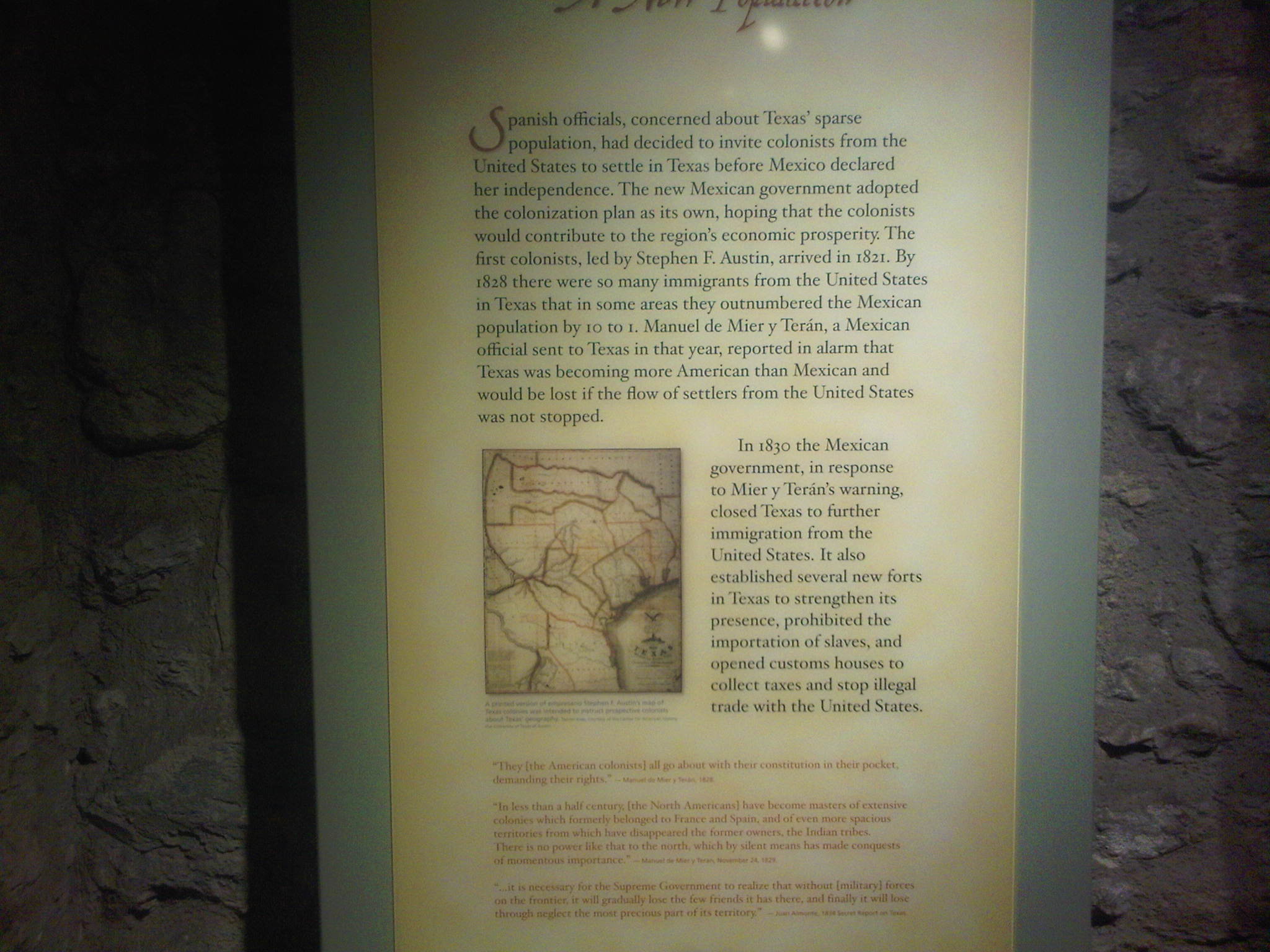
I’ve been meaning to post this picture for some time. Participating in a great Tweetchat last night #Latism reminded me to do it.

Here’s a picture of a historical placard located in the Alamo in San Antonio. (I’m there often because my mom has a home in the Hill Country of TX.)

History Placard at the Alamo

Zooming in on the text:

I have no huge point to make here other than note, as I’ve done before, that irony is the most powerful force in the universe. (Also I was reminded by the folks in #Latism last night that, as this text implies, the Mexican Government also had a problem with the settlers owning slaves.)  And perhaps this can serve as a small antidote to the self-righteous and smug tone of many (not all) in the immigration debate.

Thoughts for the New Year

Does my right to privacy extend to the right to be invisible?

Are humans basically good or bad?

Why do we try to control others?

Why do we tolerate such a sub-optimum nation-state system?

Is the material world the only reality?

Something big is going on right now in how we humans organize our societies and our lives. Most people don’t deny that now even though I still encounter folks who ask me whether all this social media is just a fad. I’m full of optimism about how humans will continue to learn and thus improve our lot. These steps forward are not for anyone to prescribe; they will emerge from our interactions and our improving ability to record and share our experiences.

Still there are some habits of thought, propositions that are too often accepted as true in public discourse, that stand in the way of that forward momentum. In my view, they’re increasingly not true but I must admit also tremendously stubborn in their influence. These 5 mental frameworks, most of which have been with us for a very long time, for the most part create friction and inefficiencies in human society. I’m betting that in the years to come they will all be recalibrated as we work to achieve a fuller human potential.

Does my right to privacy extend to invisibility? OK, I admit this is a relatively new difficult question. It’s been with us for most of the post WWII period but sharpened acutely in the last five years. But here is the distinction I want to make. Much of what we think of as privacy issues in this social media/Facebook/Twitter/Google Latitude/pervasive video cameras-engineered world aren’t really privacy issues at all. They are visibility issues. When I go to the store to buy milk, I’m not trying to keep that transaction “private.” It of course would be impossible to do so. What’s really different is that by checking in on Four Square or using my loyalty card or simply carrying my smart phone (really consumers lost this battle a long time ago!!) I am making the transaction more visible (and more important recordable and thus analyzable). There are legitimate privacy concerns out there: I don’t want everyone to know my bank balance or my SSN but it’s important to distinguish that much of what we are fretting about is a new kind of visibility, not an invasion of privacy. If something bad happened on the way to the grocery store–if I backed into a car leaving the parking lot and fled the scene–the police would immediately look for people who “saw what happened.” I would not be able to claim a right to privacy because none exists. Why is any of this relevant? A society that understands more of what is happening will be a smarter society and should make better decisions. I would be smarter about myself if I understood the patterns of my own life better. And a society with improved understanding should be able to self-organize more effectively. Again, it’s not my intent to argue for the right trade-off between visibility and invisibility. We will work this out over time with the usual fits and starts. I just believe we’re confusing two important terms–privacy and visibility.

Are humans basically good or bad? I’m in the basically good camp, always have been, although I would phrase it a little differently. I think humans are usually well-intentioned but feckless. I think bad behavior follows bad decisions and bad outcomes, not the other way around. Most people don’t set out to do the “wrong” thing; they think they are choosing the best option, although admittedly there is plenty of delusional thinking out there, and frankly absence of thinking, not to mention hyperactive lizard brain. (Absence of knowledge and lack of understanding of other perspectives also contribute to the bad decisions that lead to bad behavior.) But when the decision begins to go bad and they are scrambling to recover, that’s when I think humans most often fall into the bad behavior trap. They run with their survival instincts, which evolution tells us are largely selfish. So to return to the visibility issue, if you think humans are basically bad then no wonder you worry about what people will do with all that information about you. My friends who ask me if social media are a fad also like to ask me if I’m not worried about all the information that is out there about me. Well as an optimist about human nature I’m not worried. And even if I were to worry, I trust that the general lack of feck will waylay most plans to do bad by me.

My first point here is that I really hope we humans can get beyond this debate about our basic natures sometime soon. I am biased here as to what I think the right answer is. The belief that humans are basically bad, in my view, is the driver behind many institutions/processes that over-control and micromanage. But I also recognize that we will only bury the humans-are-basically-bad meme through a long record of actions, fueled by truly millions of personal conversion experiences. My second point: if you are an advocate of self-organizing communities, you are essentially assuming people are basically well-intentioned and that more, shared information will allow them to make better decisions. So it’s best not to mock people who don’t get it; I know I’m guilty of that myself sometimes.

Why do we try to control others? The belief that you know the right way and your job is to force others to accept that truth is the single most destructive quality in humans, in my view. It must also have some significant evolutionary benefit for it to persist. If you’re asking: well, isn’t your writing of this blog an indication you too want a slice of that control, then I have to admit you have a point. I think enough of my views to try to express them carefully, although luckily I can’t force anyone to read my blog. Indeed, this is why this particular drive is so seductive and so strong in so many individuals, even those that start off with the best–that word again–intentions. I believe our human potential will be best expressed when we minimize our control instinct, but I’m not sanguine this will happen quickly. But it will happen. Governments and organizations built on the desire and need to control others will eventually contract as individuals learn–and have the capabilities–to manage most of the transactions themselves.

Why do we tolerate such a sub-optimum nation-state system? Why indeed? You know, I worked for 32 years in one of the great creations of the modern nation-state, the Intelligence Agency, so you would think I’d know better than to ask such a question. After all, I must be a realist, right? But nevertheless I’m puzzled more people don’t question why we tolerate such a nutty arrangement. The nation-state system, and here I’m speaking specifically about how countries relate to each other, runs on a set of rules–spoken and unspoken–that have been largely discredited in and abandoned by other systems. The nation-state system still assumes the inevitability of conflict, the need to expect the worst from others, the need to hide things from and trick others, the wisdom of short-term, grab-it-while-you-can thinking, etc. etc.  (There was recently a good article in Financial Times by Parag Khanna describing how the world system might evolve differently.)

The reason I phrased the question the way I did is because I think the answer is in the question. The nation-state system exists as is because we tolerate it. In fact, we more than tolerate, we accept it and some–neocons and marxists, for example?–revel in it. We are complicit. What will be interesting to see is the reaction of nation-states as individuals and communities begin to distance themselves from their status quo. You see the beginnings of this today as individuals, many of them completely delinked from their nation-state identities, interact with each other seamlessly across Twitter and other social media. If you dismiss such thinking as utopian or pollyanish, fact is humans have already broken at least twice in our history with very powerful governing systems–Royalty and Churches. But both aristocracy and the church heirarchy went down swinging and I’m betting the governing class will find it hard to accept its displacement. Stay tuned, more coming.

Is the material world the only reality? Well, in for a penny, in for a pound. If you don’t already think I’m nutty, this will convince you. But as I read about theoretical physicists struggling to understand the universe or universes, I can only surmise that our own existences are more complex than just the physical entities we know. Understanding what that exactly means is a purpose for human existence. We exist in large part to understand. And we understand better together.

What To Say about Wikileaks

Now that Clay Shirkey has posted the following on Wikileaks, there’s very little left for me to say. Shirky expresses I hope the discomfort of many when they read of otherwise wise individuals embracing the idea of extralegal action against Wikileaks (including thinly veiled threats of violence.) Are people nuts?

So I’ll restrict my comments to some thoughts about how the Wikileaks/open internet controversy appears to me to be part of the next big battle in the millenia-long war over the proper relationship between government and society.  When I was a kid in college, some 35 years ago, I came to hope that government is in essence a temporary construct, a necessary evil. Humans need to cooperate on a whole host of transactions to make living with each other more pleasant, particularly as we clumped into larger and larger groups, and for millenia we’ve decided to hand over day-to day responsibility for this management function to something we call government. Actually we didn’t quite always hand it over; in the beginning some people or institutions such as warriors, priests, or religions actually just kind of grabbed the power and the populations essentially acquiesced. But even before the ancient Greeks, some communities were trying to figure out ways to handle these transactions and resolve differences in ways that didn’t require the creation of a permanent governing class, which unfortunately throughout history has tended to acquire a PERSONALITY OF ITS OWN, and, darn it, not always a very pleasant one.

So for all my adult life, I’ve been kind of a practical libertarian in the sense I always thought government was a lamentable but unavoidable fact of the human condition. (Along with this conviction, is the related view that the worst characteristic of humans is the desire to control others–the conviction that “I know the best way forward and you’re going to follow me or else.” (I’m afraid, based on admittedly incomplete knowledge, that Julian Assange suffers this all-too-common affliction) That’s why I tweeted the other day that the people I most admire in history have been those with radical goals who adopted moderate tactics. It’s always seemed to me that your pursuit of change always has to leave open the possibility you might be wrong and/or that better ideas exist. Going a little bit more slowly than your ardent followers would want is one way of accommodating that possibility.)

But back to imagining a good world with minimal Government. In the last ten years or so,  the internet revolution, the ability to link millions across the globe in essentially peaceful dialogue (Twitter) got me to hoping  we might eventually think our way through to a self-organizing planet. Woohoo!! Now there are lots of problems, not the least of which is the “I’m right, you’re wrong”, the “I’m better, you’re not”, and the “We’re together, you’re the ‘other'” pathologies that plague the planet. I know, I know, but, gosh, a Puerto Rican can hope.

This revolution underway is not, of course, the first global revolution against previous concepts of government. The Age of Enlightenment marked by the American and French Revolutions, essentially discredited the “divine right of kings” concept of government.  And the collapse of the remaining aristocracies at the beginning of the last century brought down the idea that only a particular, genetically-defined group of people could serve as the governing class. (I know this is a distorted thumbnail view of history, I’m leaving out all the really thrilling economic bits, for example, not to mention the cultural dimension, but I’m already at 580 words…)

And so the Wikileaks controversy is unfortunately part of the next battle in this effort to define the relationship between government and society. What’s at stake in this battle is the idea that governments require secrecy and control of information to protect its citizens and that there are a lot of things that citizens just don’t need to know. Many people are arguing against this concept, including many politicians who are winning elections based on the call for more open and transparent government. Many existing governments  in power, in fact, are demanding that other governments be more open.

Now, unfortunately, I don’t think Wikileaks is a particularly good ally to have in this battle, because it is taking an absolutist position–nothing needs to be secret –and because it is increasingly clear it’s agenda is not really about open government and transparency. Before its most recent leaks, most advocates of open government probably viewed Wikileaks much in the same way Winston Churchill viewed Josef Stalin during World War II; now advocates of open government and transparency need to be clear as to whether they want Wikileaks to represent their goals and vision. I don’t.

But that doesn’t mean I completely support how governments are reacting. One of the lessons I’ve learned in life is that when something unfortunate happens, it is difficult to contain the damage; lots of other suboptimal consequences follow. Eventually we will navigate  through this period and come to a better understanding and an agreement between government and the governed as to what is appropriate transparency. I suspect this transparency will be much greater than most members of the governing class can imagine today. And it will be a necessary precondition for much greater social self-organization and much smaller and less secret government.

The Angry Birds Guide to Organizational Change

This is such a cheap, exploitative blog post that, really, I’m just ashamed of myself. But at least I can say it’s authentic. Like  several other million people on the planet recently, I’ve been playing Angry Birds. I’ve completed all the levels, but haven’t gone back to get the 3 stars. And as I whiled away, oh I don’t know, maybe ten hours on the game, about half of them on plane flights, I got to thinking, there’s something about these crazy birds attacking the Pig Castles that’s like a metaphor for organizational change, more precisely for the quixotic charge of the rebel trying to bring down the status quo. And if you know me at all, I’ve yet to meet a metaphor I didn’t fall madly, if only temporarily, in love with.

So maybe there are some people out there that haven’t played Angry Birds yet. Or, like I ten days ago, had only heard of the mania but hadn’t actually seen the game. So let me explain it briefly. These green pigs steal the eggs of some local birds. The pigs construct these Rube Goldberg-inspired castles to protect the eggs and assorted other  treasures they pick up along the way. The now Angry Birds, which have unique offensive characteristics, launch themselves against the castles like Avian Kamikaze. Your task is to direct the birds in an optimum way against the pig castles until you bring them down. Here’s a nice little cinematic trailer that summarizes the setup.

So what have I learned about organizational change from directing my birds against the Château de Cochon (sounds cooler in French, methinks.)

1. It’s all about the angle of attack. Not all the birds are equally powerful, some drop bombs, some mirv into multiple birdheads, others speed up and penetrate the targets like torpedoes. But it’s rare for a bird, until the end when the Red Giants emerge, to be able to take down the Pig Castles or even do much damage unless you precisely aim it at a critical junction or weak point. We organizational heretics, we would-be topplers of the status quo really spend too much time on frontal assaults, getting beat up because we’re not willing to analyze the best place, time and way to make our arguments.

2. It’s all about trail and error. I know there are some gifted Angry Bird players who never waste a shot, but for most of us the sweetness of the game play is in the learning slowly, often painfully incrementally, the best way to get to the pigs. Here’s a part of the metaphor that doesn’t apply that well to organizational change. The rebels and organizational heretics certainly don’t get that many chances to reshape an organization. But we do usually get at least a couple. Observe what goes down very carefully. Learn from it. Share lessons within your rebel alliance. And then, like the birds, take a couple of aspirin, dust yourself off, and try again. BUT IN A DIFFERENT SPOT.

3. Stop banging your heads against Brick Walls.

4. Show some patience and let some of your moves play out over time. Angry Bird kamikaze attacks against Pig Castles often play out slowly. Sometimes when you don’t think you’ve landed a particularly powerful blow, the superstructure nevertheless begins to sway just enough to bring down the entire Château.

5. Resistance can be found in unexpected nooks and crannies. At the higher levels of Angry Birds, there can be upwards of a dozen pigs in the castle. Naturally, we concentrate on bringing down the obvious Pig Leaders, but even when we’ve used up all our bird attacks, a small seemingly insignificant pig lurks in the tall grass to defeat us.

6. It’s all about the sequencing. The larger Château de Cochon can require about ten Angry Bird attacks and many of your early launches appear to do very little damage to the superstructure. But your final assaults won’t succeed without those early attacks. All organizational heretics need to think hard about where to begin their campaign against the status quo. And organize it like a campaign!!! I think one of the things that kills change initiatives is that the status quo defenders have much better tactics and strategies than the change advocates.

And Finally…

7. Sometimes you just have to chip away.

Anyway, that’s what playing Angry Birds taught me about organizational change. Any others?

Do We Have to Choose between Transparency and Real Authority?

A friend sent me this email in response to my last blog post. He has agreed to let me post his thoughtful reply on my blog:

I enjoyed your recent blog post “Five Scary Thoughts for Halloween“.

I wanted to push back on your first scary idea (actually listed as number five) about making your ideas public.   The story you used involved a man who doesn’t even own a computer and his inability to comprehend why someone would want to share their ideas.

My question to you is who is more out of touch?  Him or you? How powerful was this man?  How much authority does he wield?  If refusing to share broadly is such a disability in today’s networked world, why do so few people who have power and authority actively engage in the conversation?  Could it be because they have real power and authority?

I may be reading more into your scary idea than you intended as you only speak about the complexities of the challenges we face.  However, your statement exudes the air of someone who feels all but certain their view is right when all of the evidence around us suggests that traditional power comes through quiet networking amongst a select group of individuals of roughly equal stature.   Even powerhouses who participate broadly in today’s global conversation make their deals in private meetings, not in public.   The real decision over who will partner with whom to accomplish something remains opaque until well after the deal is sealed.

I do believe we are on the fault line of two tectonic plates colliding (opacity and transparency) and that, at least at the moment, transparency is putting up a good fight.   If history is any guide, the opacity plate has tremendous resistance to movement and often lurches back in earthquake-like convulsions.   I think the lack of trust of large organizations today is interlinked with this idea.  Large organizations are always complex jumbles of partially formed deals, challenges, and new ideas.  Organizations have to lie to anyone outside their walls to protect those ideas (intellectual property, legal issues, pre-decisional material, etc) as well as their very existence and thus there is real schizophrenia in their actions.  When confronted with one of these falsehoods they rationalize their actions by saying “we weren’t at liberty to divulge that information at the time” or “that was proprietary information” or “it would be improper to talk about the deal before it is finalized” or “it was classified”.  To those outside though each episode is another withdrawal from the trust bank account.   Yet, the folks in charge of these organizations wield tremendous power and can, for the most part, weather these storms because the entire apparatus around them is designed to protect them and keep itself going.   They have tremendous capital.  They have tremendous legal authority.  They have tremendous ability to legislate, investigate, shape, pressure, buyout, and influence.

In your recent speech you described two possible models for the “motor” that runs the world and then proceeded to categorize people by which motor they believe is the true driver of world events.  This duality, IMHO, misses nuance and complexity.  For instance, a third model, can be some weird hybrid in which the benefits of large high-mass organizations as described above sustain opacity and give those who run them very real advantages even if they aren’t consciously and intentionally undertaking “secret agreements and machinations” but rather just trying to advance and protect their organization. That same size and complexity creates vulnerabilities and blind spots to the organic and unpredictable nature of the world in which they reside.  Historically, the benefits of the large organization have outweighed the disadvantages.  The question in my mind is whether that equation is changing.

As a complex planet with complex problems will we always need these large complex organizations from Exxon to the USG to Salvation Army to manage the globe’s complexity?   If the answer is yes, then I believe it is likely the primary centers of power will almost certainly continue to reside with folks who do not broadly share their views and ideas  in a global conversation because the organizations around them will demand they remain silent for a whole host of reasons and because to succeed in those organizations requires cunning and bureaucratic savvy that is the antitheses of a dynamic dialog.   When transparency gets too close to unraveling these centers of power, they use their heft to put things back in the bottle.  As one example, a researcher used publicly available information to show all of the infrastructure that was below Manhattan only to have the “system” react by classifying the report and having it removed from the web. When RIM provides security that is too good, India demands a back door, as does the US, as does Saudi Arabia, and countless others.   Products quietly are discontinued.  Tools quietly disappear.  Information quietly disappears from Google.  Capabilities are hobbled.   The examples are too numerous to count.

If the answer is no, large organizations are not required (maybe not even healthy) for the planet to effectively deal with the complexity of the challenges we face as a global community and a global society, what does that transition look like?